Total Pageviews

Sunday, January 28, 2024

Nichiren view of fame and profit differs from the Soka Gakkai's (Ikeda Shu or teachings)


Nichiren teaches,  "Leave such matters [worldly fame and profit] to the karma formed in your previous existences." -- Questions and Answers about Embracing the Lotus Sutra page 63

SGI, on the other hand, teaches that it is determination [Ichinen] that determines such things. 

Nichiren also teaches:

"How terrible are the slanders Nichiren has committed in his past and present existences! Since you have been born into this evil country and become the disciples of such a man, there is no telling what will happen to you. The Parinirvāna Sutra states: “Good man, because people committed countless offenses and accumulated much evil karma in the past, they must expect to suffer retribution for everything they have done. They may be despised, cursed with an ugly appearance, be poorlyclad and poorly fed, seek wealth in vain, be born to an impoverished and lowly family or one with erroneous views, or be persecuted by their sovereign.” It continues: “They may be subjected to various other sufferings and retributions. It is due to the blessings obtained by protecting the Law that they can diminish in this lifetime their suffering and retribution.” Were it not for Nichiren, these passages from the sutra would virtually make the Buddha a liar. The sutra says, first, “They may be despised”; second, “They may be cursed with an ugly appearance”; third, “They may be poorly clad”; fourth, “They may be poorly fed”; fifth, “They may seek wealth in vain”; sixth, “They may be born to an impoverished and lowly family”; seventh, “They may be born to a family with erroneous views”; and eighth, “They may be persecuted by their sovereign.” These eight phrases apply only to me, Nichiren.

One who climbs a high mountain must eventually descend. One who slights another will in turn be despised. One who deprecates those of handsome appearance will be born ugly. One who robs another of food and clothing is sure to fall into the world of hungry spirits. One who mocks a person who observes the precepts and is worthy of respect will be born to an impoverished and lowly family. One who slanders a family that embraces the correct teaching will be born to a family that holds erroneous views. One who laughs at those who cherish the precepts faithfully will be born a commoner and meet with persecution from one’s sovereign. This is the general law of cause and effect.

My sufferings, however, are not ascribable to this causal law. In the past I despised the votaries of the Lotus Sutra. I also ridiculed the sutra itself, sometimes with exaggerated praise and other times with contempt—that sutra as magnificent as two moons shining side by side, two stars conjoined, one Mount Hua placed atop another, or two jewels combined. This is why I have experienced the aforementioned eight kinds of sufferings. Usually these sufferings appear one at a time, on into the boundless future, but Nichiren has denounced the enemies of theLotus Sutra so severely that all eight have descended at once. This is like the case of a peasant heavily in debt to the steward of his village and toother authorities. As long as he remains in his village or district, rather than mercilessly hounding him, they are likely to defer his debts from one year to the next. But when he tries to leave, they rush over and demand that he repay everything at once. This is what the sutra means when it states, “It is due to the blessings obtained by protecting the Law.” -- Letter from Sado

and

"Answer: A bronze mirror will reflect color and form. The First Emperor of the Ch’in dynasty had a lie-detecting mirror that would reveal offenses committed in this present life. The mirror of the Buddha’sLaw makes clear the causal actions committed in the past. TheParinirvāna Sutra states: “Good man, because people committed countless offenses and accumulated much evil karma in the past, they must expect to suffer retribution for everything they have done. They may be despised, cursed with an ugly appearance, be poorly clad andpoorly fed, seek wealth in vain, be born to an impoverished and lowly family or one with erroneous views, or be persecuted by their sovereign. They may be subjected to various other sufferings and retributions. It is due to the blessings obtained by protecting the Law that they can diminish in this lifetime their suffering and retribution.”

This sutra passage and my own experience tally exactly. By now all the doubts that I have raised earlier should be dispelled, and thousands of difficulties are nothing to me. Let me show you phrase by phrase how the text applies to me. “They may be despised,” or, as the Lotus Sutrasays, people will “despise, hate, envy, or bear grudges against them”—and in exactly that manner I have been treated with contempt and arrogance for over twenty years. “They may be cursed with an ugly appearance,” “They may be poorly clad”—these too apply to me. “They may be poorlyfed”—that applies to me. “They may seek wealth in vain”—that applies tome. “They may be born to an impoverished and lowly family”—that applies to me. “They may be persecuted by their sovereign”—can there be any doubt that the passage applies to me? The Lotus Sutra says, “Again and again we will be banished,” and the passage from theParinirvāna Sutra says, “They may be subjected to various other sufferings and retributions.” [These passages also apply to me.]

The passage also says, “It is due to the blessings obtained by protecting the Law that they can diminish in this lifetime their suffering and retribution.” The fifth volume of Great Concentration and Insight has this to say on the subject: “The feeble merits produced by a mind only half intent on the practice cannot alter [the realm of karma]. But if one carries out the practice of concentration and insight so as to observe ‘health’ and ‘illness,’ then one can alter the cycle of birth and death [in the realm of karma].” It also says, “[As practice progresses and understanding grows], the three obstacles and four devils emerge in confusing form, vying with one another to interfere.”

From the beginningless past I have been born countless times as an evil ruler who deprived the votaries of the Lotus Sutra of their robes and rations, their fields and crops, much as the people of Japan in the present day go about destroying the temples dedicated to the Lotus Sutra. In addition, countless times I cut off the heads of the votaries of the Lotus Sutra. Some of these grave offenses I have already paid for, but there must be some that are not paid for yet. Even if I seem to have paid for them all, there are still ill effects that remain. When the time comes for me to transcend the sufferings of birth and death, it will be only after I have completely freed myself from these grave offenses. My merits are insignificant, but these offenses are grave.

If I practiced the teachings of the provisional sutras, then these retributions for my past grave offenses would not appear. When iron is heated, if it is not strenuously forged, the impurities in it will not become apparent. Only when it is subjected to the tempering process again and again will the flaws appear. When pressing hemp seeds, if one does not press very hard, one will not get much oil from them. Likewise, when I vigorously berate those throughout the country who slander the Law, I meet with great difficulties. It must be that my actions in defending the Law in this present life are calling forth retributions for the grave offenses of my past. If iron does not come into contact with fire, it remains black, but if it contacts fire, it turns red. If you place a log across a swift stream, waves will pile up like hills. If you disturb a sleeping lion, it will roar loudly." -- The Opening of the Eyes

Correcting wrong thought is the compassionate practice for this muddled age

 Compassion and correcting wrong thought

Someone on the Independent Sangha wrote:

"This is a point that is not only in Nichiren Buddhism - the Christians, the Jews, and other religions have broken down into different ways in which to practice. Hence sects in Buddhism. people imho strive to be individuals, unique - I am not sure many wake up and say I want to be part of a group where we all do the exact same thing. Go to a Jehova meeting, white shirts, women in dresses, the main person reading on stage reads from their bible or watchtower. they are carbon copies of each other. they do not have branches, sects or any differences between them. actually I think they are the only whole religion in the world. what you are saying sounds to me like you feel that the only way for Buddhism to be whole is be all the same. I say how boring. no need for conversation, or questions... squash all seeking spirits. Just follow the one in front of you and if you turn around the one behind is doing the same so it does not matter which direction you are going it is all the same. rather than be carbon copies why not just stop fighting? Isn't fighting anti-Buddhist? Respect and metta - compassion and understanding will bring light to Buddhism.' 

Response: 

Correcting wrong thought is the practice of the Bodhisattvas of the Earth in the Latter Day. It was the practice of Shakyamuni Buddha and Nichiren Daishonin. Lets take your idea to its logical conclusion...One school or individual decides it's ok to chant the Daimoku and to worship Amida Buddha. This person or sect calls itself Nichiren Daishonin's Buddhism or "I am a Nichiren Buddhist" because they chant the Daimoku of the Lotus Sutra. Many people will get the insanely wrong idea that this is correct and some will even be led to believe that Nichiren Daishonin believed that all teachings lead to Buddhahood. Another places a statue of Jesus on the altar and instructs others that individual destiny is shaped by a greater being . This person too, erroneously believes that as long as one chants the Daimoku he is a Nichiren Buddhist. Yet another is a Japanese militarist like Ishiwara who believes and teaches that Japan has a mandate to spread the Daimoku by whatever means. He assembles several divisions of zealousnyouth, arms them to the teeth and indoctrinates them with the Lotus Sutra teachings, "We do not value our own lives, we value only the Supreme Way." He leads them on a crusade against the Chinese heretics to convert them to the Daishonin's teachings. He not only calls himself a Nichiren Buddhist but others maintain that he is a great Wheel Turning King of Japan born to protect the Law by forcibly infusing and diffusing the teachings that have originated in Japan.* If you really study the teachings of Nichiren Daishonin and take the teachings of the Lotus Sutra to heart, you can never come to the interpretations and conclusions of these men. I would argue that they can chant the Daimoku day and night but that still doesn't make them Nichiren Buddhists. Those who continue to argue that all are Nichiren Buddhists who chant the Daimoku, regardless of their beliefs, will quickly destroy the sublime teachings of the Lotus Sutra. Anyone who fails to take the Lotus Sutra, Shakyamuni Buddha of the Juryo Chapter, and Nichiren Daishonin as teachers and who fails to take their teachings to heart, can not be considered a Nichiren Buddhist. We are all individuals by virtue of causes and conditions. This does not change by embracing the same Law, practice, and faith as Nichiren Daishonin. Damson, apple, pear and cherry blossoms are all flowers. They all grow from the earth and they are all nourished by a single shower of rain.

*One may only take up arms in defending the true Law and the believers. Nichiren taught that the way to spread the true Law is through a horizontal transmission [though the people] and vertical transmission [through converting the sovereign]. The vertical transmission too, according to Nichiren, is based on a constitution or decree of the sovereign making the Lotus Sutra the national religion. Both horizontal and vertical transmission is based on compassion, dialogue, and debate.

"Real estate professional", "Grammy award winner"", "honorary doctorate", "YMD Territory Leader", "High Priest", "blah, blah, blah"


Neither Shakyamuni Buddha nor Nichiren Daishonin would be impressed, so why should you?

"Devadatta, however, did not command such respect from others, so he began to consider whether there was not some way he could gain worldly fame that would surpass that of the Buddha." -- Letter to Horen

"They are persons who have abandoned a great doctrine and instead chosen lesser doctrines. If we judge from examples in the past, they will probably suffer for countless kalpas in the three evil paths. It is persons such as these that T’ient’ai meant when he said, “If they encounter an evil friend, they will lose their true mind.” (On the Four Stages of Faith).

"They cling to incomplete doctrines and are attached to receiving alms and being treated with deference; they recognize only false doctrines, distance themselves from good friends, approach with familiarity such slanderers who delight in attachment to the teachings of the lesser vehicle, and do not believe in the great vehicle. Therefore they slander the Law of the Buddhas.

A person of wisdom should not fear enemy households, snakes, the poison of fire, the god Indra, the roll of thunder, attacks by swords and staves, or wild beasts such as tigers, wolves, and lions. For these can only destroy one’s life, but cannot cause one to fall into the Avichi hell, which is truly terrifying. What one should fear is slander of the profound teaching as well as companions who are slanderers, for these will surely cause one to fall into the frightful Avichi hell. Even if one befriends evil companions and with evil intent spills the Buddha’s blood, kills one’s own father and mother, takes the lives of many sages, disrupts the unity of the Buddhist Order, and destroys all one’s roots of goodness, if one fixes one’s mind on the correct teaching, one can free oneself from that place. But if there is someone who slanders the inconceivably profound teaching, that person will for immeasurable kalpas be unable to obtain emancipation. However, if there is one who can cause others to awaken to and take faith in a teaching such as this, then that person is their father and mother, and also their good friend. This is a person of wisdom. After the Thus Come One’s passing, that person corrects false views and perverse thoughts, and causes people to enter the true way. For that reason, he has pure faith in the three treasures, and his virtuous actions lead others to enlightenment.” (The Problem to be Pondered Night and Day)

"It is a rare thing to be born as a human being. And if, having been born as such, you do not do your best to distinguish between the correct doctrine and the incorrect so that in the future you may attain Buddhahood, then you are certainly not fulfilling your true worth as a human being." (On Prayer)

Not sharing Nichiren's doctrines on the Lotus Sutra and Eternal Buddha, the SGI member's happiness. which are based on provisional teachings, can only be considered an ephemeral happiness.

Nichiren quotes Tientai:

"To liberate oneself from the [three-fold] world by means of the provisional [teachings] is called an ephemeral liberation." (Third Doctrine)

and

"...T’ien-t’ai and Miao-lo are commenting on this passage. In this passage of the sutra, all the teachings, from the Flower Garland Sutra, which was expounded immediately after the Buddha’s enlightenment and which combines both specific and perfect teachings, to the fourteen chapters that comprise the theoretical teaching of the Lotus Sutra, are termed “inferior teachings.” Those who delight in them are called people “meager in virtue and heavy with defilement,” and the liberation achieved through them is shown to be an ephemeral liberation." (ibid. Third Doctrine)

The peaceful practices of the Soka Gakkai, engaging the provisional Buddhists, the Christians and the Muslims, in "warm and constructive dialogue" are the practices of the first fourteen chapters of the Lotus Sutra.

"There is no true happiness other than upholding faith in the Lotus Sutra. This is what is meant by “peace and security in their present existence and good circumstances in future existences.”" (Happiness in this World)

"Now, if you wish to attain Buddhahood, you have only to lower the banner of your arrogance, cast aside the staff of your anger, and devote yourself exclusively to the one vehicle of the Lotus Sutra. Worldly fame and profit are mere baubles of your present existence, and arrogance and prejudice are ties that will fetter you in the next one. Ah, you should be ashamed of them! And you should fear them, too!" (Embracing the Lotus Sutra)

Where did we first hear the Daimoku and from whom?

We first heard the Daimoku at a time before Gohyaku Jintengo (the remotest past) from Lord Shakamuni Buddha of the Juryo Chapter of the Lotus Sutra at the Ceremony in the Air.

The Nichiren school has devolved into a hate filled battle among devils yet they criticize me for pointing this out?

Katie, apparently hasn't heard Soka Spirit, Kenshokai, and the Nichiren High Priest accuse the Nichiren Shoshu and the Soka Gakkai, respectively of blasphemy. All she hears is one man's criticisms of the above sects whose members chant Nam Myoho renge kyo. My goal, as was Nichiren's, is for the Nichiren school to return to the pre-sectarian Buddhism of Shakya Buddha. attacking me won't get us to Nichiren's goal. Attacking and awakening the members of these rebellious sects would, on the other hand, go a long way to realizing Nichiren's dream.

Sunday, January 14, 2024

Nichiren explains how the few (we) can be superior to the many (SGI)


"The sage said: “How foolish you are! Your attachment to this belief that one should abandon the few in favor of the many towers higher than Mount Sumeru, and your conviction that the narrow should be despised and the broad honored is deeper than the vast ocean. In the course of our discussion, I have already demonstrated that something is not necessarily worthy of honor simply because it is many in number or despicable simply because it is few. Now I would like to go a step farther and explain how the small can actually encompass the great, and the one be superior to the many.

“The seed of the nyagrodha tree, though one-third the size of a mustard seed, can conceal five hundred carts within itself. Is this not a case of the small containing the large? The wish- granting jewel, while only one in number, is able to rain down ten thousand treasures without a single thing lacking. Is this not a case of the few encompassing the many? The popular proverb says that ‘one is the mother of ten thousand.’ Do you not understand the principle behind these matters? The important thing to consider is whether or not a doctrine conforms with the principle of the true aspect of all things. Do not be blindly attached to the question of many or few!" -- A Sage and an Unenlightened Man

Regarding the principles that Nichiren [and I] set down, they may not resonate with you now [while the principles set down by the Soka Gakkai in the Human Revolution do resonate with you] but Nichiren has this to say:

"When ordinary people in this latter age read these various sutras, they suppose that these sutras accord with the mind of the Buddha. But if we ponder the matter closely, we will see that in fact what they are reading is only a reflection of their own minds. And since their own minds are naturally uncultivated, there is little merit to be gained thereby.

The Lotus Sutra, on the other hand, is known as a sutra that was preached in accordance with the Buddha’s own mind. Because the Buddha’s mind is an excellent mind, persons who read this sutra, even though they may not understand its meaning, will gain inestimable benefit."

Some writings of Nichiren on debate, especially regarding the True Word Teachings and SGI's adoption of the True Word principle of Yuiga (Guru) Yoga and their reliance on the person rather than the Law.

Condolences on  Deceased Husband

"Thus in the reign of a worthy ruler, if there is a sincere desire to strengthen the Buddhist teachings, then the ruler will give heed to both sides of a debate and will take as his teachers those wise men who put forth the most compelling arguments. In this way the nation will be assured of peace and security. So we see that the rulers of the Ch’en and Sui dynasties in China summoned the Great Teacher T’ien-t’ai Chih-che and set him to debating with the leaders of the various schools of northern and southern Buddhism, and Emperors Kammu and Saga in Japan arranged for the Reverend Saichō to debate with fourteen Buddhist leaders of Nara, the southern capital. Depending upon who was the winner in such debates, the rulers then established temples and set about propagating the correct teaching."

Likewise, the various Nichiren schools utilized this standard when debating among themselves in order to obtain temples either by donations from the people or by the powers that be.

In Letter of Instruction on Debating the Doctrine , Nichiren commented on a debate between Shijo Kingo and a Tientai priest who, despite embracing the Lotus Sutra, misunderstood the passage of the “the true aspect of all phenomena". He goes on to say:

"But these days when the members of the Tendai school conduct their interpretations of doctrine, in which they “open up and merge” [the provisional teachings with the true teaching]*, they understand this passage of the sutra wrongly, and this leads them into opinions that are erroneous."

The proper understanding of the “opening up and merging” effected by this phrase, “the true aspect of all phenomena,” is simply to uphold the Lotus Sutra, chant Namu-myoho-renge-kyo, and have faith in the words “honestly discarding expedient means, I will preach only the unsurpassed way.”** This is because Shakyamuni Buddha, the Thus Come One Many Treasures, and the Buddhas of the ten directions and the three existences have all testified to the truth of these words.

* The absolute Myo

** The comparative Myo

The Soka Gakkai is far worse. While opening up and merging the Shingon (True Word) Teachings of Yuiga Yoga (Guru Ikeda Yoga) with the Lotus Sutra, they don't instruct on the teachings found in On Repaying Debts of Gratitude to "rely on the Law and not on the person other than the BUDDHA" (and by extension Nichiren Daishonin). By all means, Nichiren utilizes the absolute myo, citing passages of various sutras to praise and edify an understanding of the Lotus Sutra but never the faith and practice of the other Sutras. On the other hand, Soka Gakkai's faith and practice revolves around the Shingon teachings of Yuiga (Guru) Yoga. In other words, they have a faith and practice of the absolute Myo without forcefully acknowledging the comparative Myo (how inferior is the faith and practice of Guru Ikeda Yoga to the Lotus Sutra and Lord Shakya of the Original Doctrine. Let us not forget the many dozens of writings by Nichiren on debating with the True Word. No doubt had any of his disciples adopted a major principle of the True Word teachings as Soka Gakkai, he would wish to debate with them as I.. Even the SGI in the Background of Questions and Answers on the Various Schools delves into this matter of the Absolute and Comparative Myo but, because they fail to see themselves, they say nothing at all about their slander of faith and practice of the Truen Word Teachings. Nichiren writes about those who recite the Lotus Sutra (Myoho renge kyo) but destroys its intent in several Goshos. SGI, NST, NS, HBS are examples Here however, I only discuss the example of the Soka Gakkai.

In Establishing the Correct Method of Contemplation, Nichiren writes:

"But when debating these matters with followers of other schools, one should confine the discussion to matters dealing with general principles. Thus, for example, one should point out that if T’ien-t’ai’s Great Concentration and Insight were not based on the Lotus Sutra, then it should be summarily discarded. Why? Because the Great Teacher T’ien-t’ai himself stated emphatically, “That which accords with the sutras is to be written down and made available. But put no faith in anything that in word or meaning fails to do so.” The Great Teacher Dengyō said, “Depend upon the preachings of the Buddha, and do not put faith in traditions handed down orally.” The Treatise on the Great Perfection of Wisdom of Nāgārjuna says that one should rely on treatises that are faithful to the sutras, but not rely on those that distort the sutras. And Shakyamuni, the lord of teachings, said, “Rely on the Law and not upon persons.”

Lastly, SGI embraces with their whole hearts The Record of the Orally Transmitted Teachings, a blatant forgery. Therefore. this is another example of the SGI relying on the person rather than the Law.

Two translated passages with commentary


"In suffering, awake to the nature of suffering; in joy rejoice. Realizing both suffering and joy as they really are [tathata], chant the Namu Myoho renge kyo of the Lotus." -- Inagaki

"Suffer what there is to suffer. Enjoy what there is to enjoy. Regard both suffering and joy as facts of life and continue to chant Namu Myoho renge kyo." -- WND of SGI

Please notice, the first translated passage instructs us to awaken to the nature of both suffering and joy, to come to comprehend suffering and joy as they really are while in the second passage, we are exhorted not to examine but to merely accept. This reflects the Modus Operandi of the Soka Gakkai cult, to follow SGI/Ikeda no matter what. It does not reflect the teaching of Nichiren Daishonin

Nichiren regarding the Japanese people with comment

 Question: Among living beings there are two types of persons, evil persons and good persons. And among the various realms into which one may be born there must be good paths and evil paths. Why then should all the people in this country of Japan uniformly be destined to “enter the Avīchi hell”?


Answer: Although the number of people is very great, the karma that they create is the same in nature. Therefore they are all alike destined for the Avīchi hell. - Nichiren

  1. Too many Japanese distorted the teachings. Actual Proof is the most important of the Three Proofs. Were what they are propagating, the Lotus Sutra, we would expect them to be lessening their karmic retribution. However, the opposite is the reality of the Japanese reality. They are destroying their castle from within, killing off their own children and the entire world with their irradiated food, killing off the ocean, dumping millions, if not billions, of tons of highly radioactive water, and incinerating who knows how much contaminated garbage... These three melted down reactors and their fuel pools, many millions of pounds more than Chernobyl should have been placed in a sarcophagus and the evacuation zones should have exteneded out to include tokyo. The lies from the Japanese Government are enormous and these so callled nichiren Lotus sura Buddhists are living in the midst of this debacle. You will see, the entire Japanese nation will collapse because of their slander of the Law and the destruction of rthe dignity of human life. It is not an accident what has befallen the epicenter Japan.

    ReplyDelete
  2. Response to Katie in several parts.

    Katie states in a comment that I fail to acknowledge the actual proof of SGI/NST transmitting the Daimoku to the West. The religion of Nichiren is more than the mechanical chanting of the daimoku. For Nichiren, doctrine is of utmost importance:

    I suggest Katie plugs in "doctrine", "doctrines", "doctrinal", etc. in the SGI Library major works search engine and read the more than NINE HUNDRED references to doctrine. Here are some examples:

    "They are persons who have abandoned a great doctrine and instead chosen lesser doctrines. If we judge from examples in the past, they will probably suffer for countless kalpas in the three evil paths. It is persons such as these that T’ient’ai meant when he said, “If they encounter an evil friend, they will lose their true mind.” (On the Four Stages of Faith).

    ReplyDelete
  3. Part 2

    "They cling to incomplete doctrines and are attached to receiving ALMS and being treated with deference; they recognize only false doctrines, distance themselves from good friends, approach with familiarity such slanderers who delight in attachment to the teachings of the lesser vehicle, and do not believe in the great vehicle. Therefore, they slander the Law of the Buddhas."

    A person of wisdom should not fear enemy households, snakes, the poison of fire, the god Indra, the roll of thunder, attacks by swords and staves, or wild beasts such as tigers, wolves, and lions. For these can only destroy one’s life, but cannot cause one to fall into the Avichi hell, which is truly terrifying. What one should fear is slander of the profound teaching as well as companions who are slanderers, for these will surely cause one to fall into the frightful Avichi hell. Even if one befriends evil companions and with evil intent spills the Buddha’s blood, kills one’s own father and mother, takes the lives of many sages, disrupts the unity of the Buddhist Order, and destroys all one’s roots of goodness, if one fixes one’s mind on the correct teaching, one can free oneself from that place. But if there is someone who slanders the inconceivably profound teaching, that person will for immeasurable kalpas be unable to obtain emancipation. However, if there is one who can cause others to awaken to and take faith in a teaching such as this, then that person is their father and mother, and also their good friend. This is a person of wisdom. After the Thus Come One’s passing, that person corrects false views and perverse thoughts, and causes people to enter the true way. For that reason, he has pure faith in the three treasures, and his virtuous actions lead others to enlightenment.” (The Problem to be Pondered Night and Day)

    "It is a rare thing to be born as a human being. And if, having been born as such, you do not do your best to distinguish between the correct doctrine and the incorrect so that in the future you may attain Buddhahood, then you are certainly not fulfilling your true worth as a human being." (On Prayer)

    Not sharing Nichiren's doctrines on the Lotus Sutra and Eternal Buddha, the SGI/NST member's happiness, which is based on provisional teachings, can only be considered an ephemeral happiness.

    Continued.......

    ReplyDelete
  4. Part 3

    Nichiren quotes Tientai: "To liberate oneself from the [three-fold] world by means of the provisional [teachings] is called an ephemeral liberation." (Third Doctrine)

    and

    "...T’ien-t’ai and Miao-lo are commenting on this passage. In this passage of the sutra, all the teachings, from the Flower Garland Sutra, which was expounded immediately after the Buddha’s enlightenment and which combines both specific and perfect teachings, to the fourteen chapters that comprise the theoretical teaching of the Lotus Sutra, are termed “inferior teachings.” Those who delight in them are called people “meager in virtue and heavy with defilement,” and the liberation achieved through them is shown to be an ephemeral liberation." (ibid. Third Doctrine)

    The peaceful practices of the Soka Gakkai, engaging the provisional Buddhists, the Christians and the Muslims, in "warm and constructive dialogue" are those practices of the first fourteen chapters of the Lotus Sutra.

    "There is no true happiness other than upholding faith in the Lotus Sutra. This is what is meant by “peace and security in their present existence and good circumstances in future existences.”" (Happiness in this World)

    "Now, if you wish to attain Buddhahood, you have only to lower the banner of your arrogance, cast aside the staff of your anger, and devote yourself exclusively to the one vehicle of the Lotus Sutra. Worldly fame and profit are mere baubles of your present existence, and arrogance and prejudice are ties that will fetter you in the next one. Ah, you should be ashamed of them! And you should fear them, too!" (Embracing the Lotus Sutra)

    Teaching childen the mere baubles of how to become Trillionaires through chanting the Daimoku or that everyone is a Buddha, is hardly the faith and practice of the Lotus Sutra. Other examples of SGI mistaken Buddhist teachings are too numerous to count.

    As an aside, Nichiren Shoshu's doctrine of High Priest, going so far as to permit the High Priest to create or to altar Gosho and call it "Nichiren's Gosho", is even more perverse.



The Lotus Sutra, Chapter 16. The Duration of the Life of the Tathagata - a lecture by the Kempon Hokke Priest, Reverend Tsuchiya


"Tathagata is not a thing like the truth itself. Tathagata has a character and is always saving pitiful people actively. As say "I always expound the teachings to educate zillion people and let them enter the way to Buddhahood", Tathagata has been saving people from the remote past to the present by giving teachings mainly. It is neither a cool truth nor inanimate letter. Tathagata who has a character as a real existence philosophically is continuing activities. That is said in Kempon Hokke shu as "Manifest-body which always exists." Manifest-body which always exists does not mean that the body of Tathagata who has appeared in India always exists. About three bodies of Tathagata, Dharma-body (法身) is to indicate the truth, Reward-body (報身) is to indicate the wisdom, and Manifest-body (応身) is to indicate the compassion. Needless to say, Tathagata has the truth, the wisdom, and the compassion. However, the aspect of compassion to save people stands in the front as a character of Tathagata, not as the aspect of truth, not as the aspect of wisdom. By tabulating the compassion, wrapping the wisdom and the truth into inside, Tathagata is active. Therefore, because of showing the compassion as a correct meaning, Kempon Hokke shu says "Manifest-body always exists." It is said as the application of the truth of Manifest-body and the sentence of 'no beginning, no end' of Manifest-body, which are said in Kaimoku-sho. Tendai school makes the Reward-body central as the wisdom, and Shingon school makes the Dharma-body central as the truth. However, Nichiren shonin emphasizes that the compassion of the Buddha who has three bodies as one body is the front. The evidence is that Tathagata is always educating people and is saving people by causing compassion. Kempon Hokke shu has been saying it since old times.

The similarity of Shingon (Son of Heaven) and Christianity (God)


"Later, in the reign of Emperor Hsüan-tsung, the Tripitaka Master Shan-wu-wei journeyed to China from India, bringing with him the Mahāvairochana and Susiddhikara sutras. In addition, the Tripitaka Master Chin-kang-chih appeared with the Diamond Crown Sutra. Moreover, Chin-kang-chih had a disciple named the Tripitaka Master Pu-k’ung.

These three men were all Indians who not only came from very distinguished families but were in character quite different from the priests of China. The doctrines that they taught appeared highly impressive in that they included mudras and mantras, something that had never been known in China since the introduction of Buddhism in the Later Han. In the presence of this new Buddhism, the emperor bowed his head and the common people pressed their palms together in reverence.

These men taught that, whatever the relative merits of the Flower Garland, Profound Secrets, Wisdom, Nirvana, and Lotus sutras might be, they were all exoteric teachings, the various preachings of the Thus Come One Shakyamuni. The Mahāvairochana Sutra that they had newly introduced, on the other hand, represented the royal pronouncements of the Dharma King Mahāvairochana. The other sutras were the multiple sayings of the common people; this sutra was the unique pronouncement of the Son of Heaven. Works such as the Flower Garland and Nirvana sutras could never hope to reach as high as the Mahāvairochana Sutra even with the help of a ladder. Only the Lotus Sutra bears some resemblance to the Mahāvairochana Sutra.

Nevertheless, the Lotus Sutra was preached by the Thus Come One Shakyamuni and thus represents merely the truth as spoken by a commoner, while the Mahāvairochana Sutra represents the truth as spoken by the Son of Heaven. Hence, although the words resemble each other, the persons who spoke them are as far apart as the clouds in the sky and the mud on earth. The difference between them is like the moon that is reflected in muddy water on the one hand and in clear water on the other. Both alike are reflections of the moon, yet the nature of the water that catches the reflection is vastly different." - On Repaying Debts of Gratitude

Soka Gakkai is not a follower of Nichiren


SGI is not a follower of Nichiren. SGI practices interfaith. SGI models itself on the Shingon principle of Yuiga-Yoga or Guru-Yoga. As Shingon, SGI depreciates Shakyamuni Buddha. As Zen, there is a follow no-matter-what patriarchal hierarchy. SGI rejects all Nichiren priests who are not obsequious to the SGI Presidents 

Toda taught in his Lecture on the Sutra: “With this silent prayer, we express our sincere thanks to the Second High Priest Nikko Shonin, the founder of Head temple Taisekiji. Hossui-shabyo: Hossui is the Law or Buddhism metaphorically compared to clean water. Shabyo means “transfer. Now suppose here are two glasses, one of which is filled with water. The water is transferred from one glass into the other. The quality of the water remains unchanged through this transfer even though the shapes of the glasses may differ. Simililarly, the Hossui of Nichiren Daishonin was handed down from Nikko Shonin to Third High Priest Nichimoku Shonin. However, its genuine purity was not changed in the least. This solemn tradition has been strictly maintained by the successive high priests of Nichiren Shoshu. YUIGA YOGA: This means that the life of Nikko Shonin equals that of Nichiren Daishonin. A Gohonzon called the “Tobi” (Flying) Mandala” is enshrined at Butsugenji Temple in Sendai City in Northeast Japan. It was inscribed co-operatively by the Daishonin and His immediate successor Nikko Shonin. This fact evidences what yuiga yoga signifies.” – Josei Toda as quoted in: From “Lectures on the Sutra” Third Edition, 1968 Seikyo Press.

Please note that no where in the Lotus Sutra or the writings of Nichiren Daishonin, can we find the concepts or words, YUIGA YOGA but in Tendai/Shingon esotericism, this is a core principle. Central to Lamanism, an offshoot of Shingon, are the Four Treasures and the most important Treasure is the Treasure of the Guru. The other Three Treasures are subsumed within the Treasure of the Guru. This is known as Guru Yoga. The same goes for the SGI, whether it is implicit or implied. When SGI members or leaders chant Namu Myoho renge kyo, they are revering their Sensei. While they chant Namu Myoho renge kyo with their voices, they chant Namu Sensei in their hearts.

Makiguchi and Toda read the Lotus Sutra according to the distorted teachings of the Taisekaji priests who adopted the two related Zen and Shingon concepts respectively: The Transfer of the Water of the Law; and Yuiga Yoga or the Oneness of living Master and Disciple. The SGI has adopted these distorted Zen and Shingon viewpoints, in contrast to the Lotus Sutra and writings of Nichiren Daishonin which state, “This Sutra”.

More proof of SGI’s transgressions are Daisaku Ikeda’s teachings that mirror those of his deluded Sensei, Josei Toda. Ikeda once taught, “The basis of Nichiren Shoshu is the Lifeblood received only by a single person. To faithfully follow the High Priest of the bequethal of the Lifeblood is the correct way for priests and lay believers. If one is mistaken about this single point, then everything will become insane.” And now he declares, “Following the Three Presidents of the Soka Gakkai is the basis of the Lifeblood of faith”.

Doctor Daisaku Ikeda, ironically, was born into a household whose ancestors reside in Mitsugonin, a temple of the Shingon sect. It is a slanderous place which was established in accordance with Shingon formalities. The Shingon patriarch, the Learned Doctor Shan-wu-wei too, despite his wisdom and strong practice, was mistaken about the teachings of Buddhism. Shan wu-wei was persecuted. Christ too was persecuted and his teachings are far less insidious than Shan-wu-wei’s, Makiguchi’s, or Ikeda’s. Their teachings resemble little the teachings of the Original Buddha Shakyamuni’s [Lotus Sutra] and Nichiren Daishonin’s. Visions and “visionaries”, not firmly grounded in the teachings of the Original Buddha Shakyamuni [Lotus Sutra] and the Daishonin, reside in the realm of delusion.

Lastly, wherever SGI founds itself, the world edges evermore towards destruction, particularly, Japan.
The Honmon Shoshu too is mistake as to the identity of the Original Eternal Buddha.


Nichiren Shonin
Gohonzon Shu


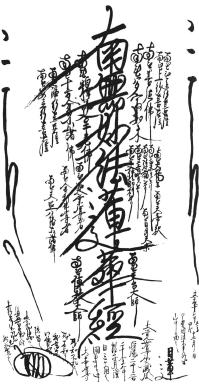
Man-nen-ku-go Dai-honzon by Nichiren; CLICK HERE to download a 5 MB bitmap


Click to learn more about the Dai-Honzon at Kitayama Honmonji

Man-nen-ku-go Dai-honzon
This Nichiren Gohonzon came into the hands of
Nichimoku's disciple Nichigo (1272-1353)
and has remained ever since at
Myohon-ji at Hota (founded in 1342).
The Koso Nempu (Chronology of the Patriarch)
in the Edo period says that it was
originally bestowed on Nikko.

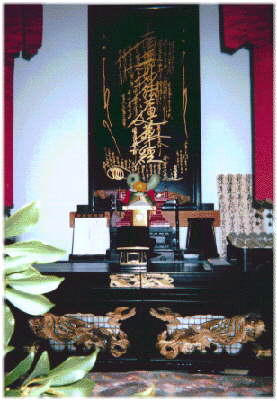
This large black wooden
Dai-Honzon replica
is enshrined at Fujisan Honmonji,
Head Temple of Honmon Shoshu.


The inscription at the bottom of this Great Mandala reads:

Since the Entrance into Extinction of the Great Enlightened World Honored One there have passed in succession more than two thousand two hundred and twenty years. Even so, among the Three Countries of India, Han [China] and Japan, there has not yet been this Great Object of Worship (dai honzon). Either they have known but not yet spread it or they have not known it. Our Compassionate Father, by means of the Buddha Wisdom, has hidden and retained it, leaving it for the Latter Age. At the time of the last five hundred years, the Bodhisattva Jogyo comes [or has come forth] forth in the world and for the first time spreads and proclaims it.

To its left is the date: The twelfth [lunar] month of the eleventh year of Bun'ei (1274) with the location in the mountains at Hakiri in the Province of Kai, i.e., at Minobusan. 

On the Hon-in-myo Dai-honzon & the Three Great Secret Laws
A Fujisan Honmonji Member's Perspective
by Eddy Chai in Singapore

The Hon-in-myo Dai-honzon (made of wood) is the one appearing on the Fujisan Honmonji newsletter (below). A statue made from the ash of Nichiren sits right before it. Hon-in-myo Dai-honzon translates as, "The Great Object of Worship of the Wonderful Original Cause." This name is given by Nichiren himself, and he carved it at the back of the Hon-in-myo Dai-honzon, along with this date: Oct 12th Koan 2nd year [1279].

The Daigohonzon that Nichiren Shoshu claimed Nikko took with him when he left Minobu is not a wooden Honzon. Rather, it is the Man-nen-ku-go Dai-honzon. The Hon-in-myo Dai-honzon was carved by Nichiren Daishonin in the likeness of the Man-nen-ku-go Dai-honzon, which is translated as, "The Great Object of Worship to Save and Protect for Ten Thousand Years." It is Gohonzonshu #16 (top left), inscribed on 3 pieces of paper joined together. It is kept in Hota Myohonji. The name "Man-nen-ku-go Dai-honzon" is its official name, and is written in the Gohonzonshu explanatory notes (bottom of page).


The Hon-in-myo Dai-honzon is the FIRST of the Honmon Three Great Secret Laws, ie. HONMON-NO-HONZON. Hon-in-myo means, "Wonderful Original Cause." Nichiren called this Dai-honzon the "Wonderful Original Cause" for a simple reason: It is the Original Cause of Enlightenment of all Buddhas in the past, present and future. We are the present and also the future. Best of all, it is the "Wonderful Original Cause" because when you have FAITH in it, it sows the seed of Buddhahood in you.

The reason this Dai-honzon is the "Wonderful Original Cause" is because it carries the presence of the Eternal Original Buddha, ie. Myohorengekyo. This is the SECOND of the Honmon Three Great Secret Laws, ie. HONMON-NO-DAIMOKU. If not for the presence of the Eternal Original Buddha, how can this Dai-honzon be called the "Wonderful Original Cause"?

Fujisan Honmonji is where the Hon-in-myo Dai-honzon is enshrined. Therefore, Fujisan Honmonji is the THIRD of the Honmon Three Great Secret Laws, ie. HONMON-NO-KAIDAN. Because it is one of the Three Great Secret Laws, it is not accurate to call Fujisan Honmonji a Fuji School. Fujisan Honmonji translates as, "The Temple of the Original Doctrine at Mount Fuji."

The 'Establishment' of the Honmon Three Great Secret Laws is now complete; without which, Kosenrufu cannot begin. The time for Kosenrufu just started. You will begin to see that this is not the Three Great Secret Laws in principle, as spoken of in previous eras, i.e., before the 'Establishment'. What you can embrace now is the Actual Three Great Secret Laws. Why Actual? Answer: Because the Three Great Secret Laws are NOW established, and available to you as a Unified Entity ; this is Honmon.

Further doctrinally:

"The living embodiment of Aizen & Fudo Myo-ou is Nichiren Daishounin refering to Himself. That is to say, via the Kankenki, Nichiren Daishounin expresses the inner awareness of His identity as the True Buddha through outwardly expressing Himself as the living embodiment of Aizen and Fudo Myo-ou.

Aizen & Fudo Myou-ou are the 2 personas located on the left and right of the Hon-in-myou Daihonzon respectively. They are the twin Laws (of the True Buddha) that guide all existence and bring order to the world. Aizen (ie. affection) represents the Buddha Law, and Fudo (ie. immovable) is the King Law. The former is the showering of the Buddha Law. The latter deals with the delivery of that Law. The Kanjin Honzon-sho states: “When the occasions requires shakubuku, the Four Bodhisattvas appear as Wise Kings who admonish and censure foolish kings, and when it is time for shoju, they appear as Priests to maintain and spread the Correct Law.”

Dainichi Nyorai (Great Sun Tathagata) in the context of the Kankenki, is not the provisional Vairochana (“Birushana 毘盧遮那”) per se preached by the Shingon Sect. The Dainichi Nyorai (大日如来) of the Kankenki is the alternate name for Oohi-rume-no-muchi (大日霊貴). That is to say, the full title of Dainichi Nyorai is Amaterasu-oohi-rume-no-muchi-daijin (天照大日霊貴大神) which is shortened to Tensho Daijin (天照大神); the Sun God. Tensho (天照) is the alternate pronunciation of Amaterasu (天照), meaning, “Heavenly Radiance” whose symbol is the Sun with 16 rays.

The “Nichi” (日) of Nichiren (日蓮) is the same “Nichi” as Dai (Nichi) Nyorai (大日如来). Nichi (日) means Sun. Calling Himself “Nichiren” is meant to show the direct link (連 ) from Amaterasu-oohi-rume-no-muchi to Himself. In other words, Amaterasu-oohi-rume-no-muchi is the prior form of Nichiren. From Amaterasu-oohi-rume-no-muchi-daijin (ie. Tensho Daijin) to Nichiren, the transmission of Myou-hou-ren-ge-kyou is represented by the Sacred Jewel; the Divine Seal of “An-Deingiru”, the Sky God of Tenjiku (天竺).

The statement: “Nichiren confers to the New Buddha” refer to a future third manifestation of the Sun God after Nichiren Daishounin. Put together, Dainichi Nyorai (ie. Amaterasu-oohi-rume-no-muchi), Nichiren, and the New Buddha are the Three Bodies revealed in the Juryo chapter of the Lotus Sutra as the Good Doctor (Ro-I 良医), the Father (Bu 父), and Messenger (Kenshi 遣使). The same Three Bodies appear also in the Hon-in-myou Daihonzon as the “Great Awakened World Honored One” (Dai-kaku-seson 大覚世尊), the Merciful Father (Ji-bu 慈父), and Bodhisattva Jogyo (上行普蕯).

Merciful Father is of course Nichiren Daishounin. And the Messenger is Bodhisattva Jogyo.

Now, what is the meaning of the Sun mentioned here? Is it the scorching sun in the sky, or what? The Sun (ie. Nichi) is actually a synonym for the True Buddha: Nichiren Daishounin. The radiance of the Sun is the Honmon no Daimoku (ie. The Good Wave Motion) shining forth from the Sun (ie. The Life of Nichiren Daishounin in the Hon-in-myou Daihonzon).

The Good Wave Motion (Hou 法) is the vibration (ie. hadou) within fundamental mass (Myou 妙) that supports Life. It is the Excellent Medicine for the Ten Thousand years of Mappo.

I hope I don't bore you, but I hope you do get to learn more about the Honmon Three Great Secret Laws. In these times of "doctrinal conflicts," truly, this is the One & Only Law that emerged to deliver us all. If you have questions, it'll be my pleasure to answer them."

My response:  How can they make claim to "The One Principle Object of Worship for all mankind" and make such a glaring mistake about the Identity of the Eternal Buddha? It is impossible.

Response to SGI leader Zafwan on Quora

Zafwan:

"The origin of OM (AUM) is attributed to the concept of Brahma-Atman. Brahma is the Universal Truth, while Atman is the Soul (of the individual). OM is meant to encode the principle that Oneness of Individual with the Ultimate Truth - is the way of salvation.

This is very similar to Nichiren Buddhism, which teaches that Devotion (Namu) or Oneness with the truth of life (MyohoRengeKyo) - is the way of salvation and attaining enlightenment. Both perspectives employ Sound (Chanting) as a sacred path of practice.While Brahma refers to the Universal Law of reality - or the Tao - then it is quite comparable with the Mystic Law (Myoho) of the Lotus Sutra.

The main difference between Hinduism and Buddhism is the concept of Atman or Soul. Buddhism focuses on the concept of Action (Karma) and rejects having a fixed soul. The reason is that one can change own karma but cannot change the fixed soul. Karma is created by the individual through the working of the Law of Cause and Effect (Renge). Renge in Nichiren chant encodes the dynamism of Simultaneity of Cause and Effect.

So one can say that Myoho Renge mirrors Brahma-Atman (but in a more dynamic sense).

A marriage between the Lotus Sutra and Hinduism presents Vajrayana Buddhism with its mantra: OmManiPadmeHum (“Praise to the jewel in the Lotus”) similar to Nichiren chanting of NamMyohoRengeKyo (“Devotion to the wonderful Law of the Lotus”)

Both chants - as well as the concept of OM - are included within in the Lotus Sutra - emphasising on the sacredness of Sound (through Bodhisattva Avalokitesvara who appears in the Lotus Sutra as Bodhisattva Kannon, Perceiver of Worlds Sounds : Avalokitasvara | Dictionary of Buddhism | Nichiren Buddhism Library

The similarities then are many and the essence is very close. But I think that OM (if understood as the universal truth) is more abstract in essence rather than NamMyohoRengeKyo - which is about individuals' devotion (Namu) or individual’s own desire and determination (to be one with the Universal Law).

Another difference is that MyohoRengeKyo encodes the Mystic Law operative in the Ten Worlds of reality (including the worlds of sufferings). To transform the worlds of individual’s sufferings - one has to be in harmony and devotion (Namu or Nam) with the Universal Truth.

This inclusion of Transformation of the worlds of reality into enlightenment gives Lotus chanting more expansive (or detailed) dimension, as the Lotus is about transformation (flourishing over mud). But in both practices it is the Sound that is the common to be viewed as sacred.

“Voice makes the Buddha’s work” - Nichiren The Voice Does the Buddha’s Work

Response to Zafwan:

In The Awakening of Faith in the Mahayana, Ashvaghosha writes:

"As the World-honored one, considering the inferior intellectual caliber of Shravakas (Men of Learning) and Pratyekabuddhas (Men of Self Realization), taught them only the doctrine of the non-personal atman, [and did not make any further demonstration of the doctrine], the people have in the meantime formed a fixed idea of the transitoriness of the five skandhas, and being terrified of the thought of birth and death, have fanatically craved for Nirvana.

In order that this clinging may be eliminated, be it clearly understood that the essence of the five skandhas is uncreate, there is no annihilation of them; that since there is no annihilation of them, they are in their [metaphysical] origin Nirvana itself."

Nichiren teaches:

“Mahākāshyapa and Ānanda,” they said, “lived on for twenty or forty years after the passing of the Buddha, preaching the correct teaching. Presumably they conveyed the heart of all the teachings that the Buddha had propounded during his lifetime. Now we find that what these two men emphasized were simply the concepts of suffering, emptiness, impermanence, and non-self. Ashvaghosha and Nāgārjuna may be very wise, but are we to suppose that they are superior to Mahākāshyapa and Ānanda? This is our first objection. 

“Mahākāshyapa obtained his enlightenment through direct encounters with the Buddha. But these two men, Ashvaghosha and Nāgārjuna, have never encountered the Buddha. This is our second objection. 

“The non-Buddhist philosophers who preceded the Buddha taught that life is permanent, joyful, endowed with self, and pure. Later, when the Buddha appeared in the world, he declared that life is marked by suffering, emptiness, impermanence, and non-self. Now Ashvaghosha and Nāgārjuna insist that it is permanent, joyful, endowed with self, and pure. This being so, we must suppose that, since both the Buddha and Mahākāshyapa have passed away from the world, the devil king of the sixth heaven has taken possession of these two men and is trying to overthrow the teachings of Buddhism and replace them with the teachings of the non-Buddhists. 

“If that is so, then these men are the enemies of Buddhism. We must smash their skulls, cut off their heads, put an end to their lives, see that they get no more to eat. Let us drive them from the country!” 

Such were the declarations of the Hinayana believers. And Ashvaghosha and Nāgārjuna, each having only a few allies, were forced day and night to listen to these shouts of calumny, and morning and evening to bear the attacks of sticks and staves. 

But these two men were in fact messengers of the Buddha. For in the Māyā Sutra, it is predicted that Ashvaghosha will appear six hundred years, and Nāgārjuna, seven hundred years, after the Buddha’s passing. The same prediction is also recorded in the Lankāvatāra Sutra, and of course in the Buddha’s Successors Sutra as well. 

But the Hinayana believers would not heed these predictions, and instead attacked the Mahayanists blindly and without reason. “Since hatred and jealousy . . . abound even when the Thus Come One is in the world, how much more will this be so after his passing?” says the Lotus Sutra. Looking at the time of Ashvaghosha and Nāgārjuna, one begins to have a little understanding of what these words of the sutra really mean. Moreover, Bodhisattva Āryadeva was killed by a non-Buddhist, and the Venerable Āryasimha had his head cut off. These events, too, give one cause for thought." - On Repaying Debts of Gratitude, one of Nichiren's Five Major Works.

Perhaps there is no Joy, "TRUE SELF", Permanence, or Purity from Zafwan's SGI practice. 

BTW There was no response from Zafwan.

Fellow believer?

Not if you continue with Soka Gakkai, Nichiren Shoshu or even the Nichiren Shu.

Monday, January 1, 2024

Breaking News....Massive earthquake hits Japan on New Years Day

https://www.yahoo.com/news/japan-issues-tsunami-warning-strong-103831146.html 

Please remember the Japanese scale numbers are considerably less than the Richter scale numbers. I estimate that the Earthquake was a 9 or better on the Richter scale. Thus the earthquake was on the scale of the 2011 Tohoku earthquake (and Tsunami) which killed 27,000 people. Earthquakes are important omens that predict either good or bad events according to Nichiren  Lotus Sutra Buddhism.